Tuesday, November 12, 2024

10 WAYS TO BREAK A READING SLUMP


As readers we all want nothing more than an uninterrupted few hours and a good book. But sometimes life takes us away from our shelves, or sometimes we get the I -Just - Don't - Wannas. I tend to have reading slumps in February, in anticipation of March and April being Women's History Months, (as my main genres are Feminist Historical Fiction and Feminist Classics.) I slow down in late April and May in anticipation of summer reading June through August. I usually take a reading vacation in September. I slowly get back into my groove in October, and hold steady November December and January. But even in those months I'm at my four to six book norm, sometimes I can't latch onto a book, or I can't find a book that interests me. So I've come up with a few ways to break those slumps : 


1 - TBR jar - this is the easiest way to break a slump : 

Take a jar

Write your TBR choices on slips of paper

Put slips of paper in jar

Shake jar

Extract slip

Read book on that slip 

plus easy, cheap, and cute bookish decor


2 - Book-Genre Mashup / Read-alikes 

Take a book, author, or genre you love, think of a genre you don't really read, then search your choices (for me Jane Austen + horror = Pride and Prejudice and Zombies.)

Or ~ if you love a particular classic, find a modern retelling in your particular genre

OR ~ I have to admit I'm not much of a romance reader, but I don't mind a cleverly crafted rom-com now and then. I know that the 5 main classic literary characters who have inspired just about every female author are Jo March, Lizzie Bennett, Anne Shirley, Catherine Earnshaw, and Jane Eyre - all characters that I admire. I can Google search authors inspired by Little Women and find books with heroines close to Jo March, etc.


3 - Watch the movie first - 

Some readers will say sacrilege, I know. If there is a book you were on the fence about reading, try the movie first. If you spark with the movie, you will probably love the book. This is how I discovered Big Stone Gap, which quickly became a frequent re-watch/re-read


4 - Book Generated Lists

I love books about book stores and libraries and I can find book recommendations easily because those books often have lists of books recommended within the story


TV Show Generated Lists

Re-binge Gilmore Girls (cuz of course, cuz Paris!) Google a list of Rory's books then read one of those books


5 - Book film or television show non - book inspiration

Don Draper often went to the movies to find inspiration (and smoke) If you are a fan of a particular show search a list of movies mentioned in the show then research those films to see if they were based on a literary work. If so read that work or find a similar book in your particular genre. If one of those films peaks your interest (for me it would be the Italian film La Notte), search for books set in the same place, time, or with the same general theme as the film


6 - Author Generated Recommendations

My celebrity crush is Nemo van Devender. He is Ann Patchett's dog. I see him every Tuesday when I watch Ann Patchett list new releases at her bookstore Parnassus books. I see Nemo again every Friday when Anne does her It's New to You videos. But while I'm crushing on Nemo I am also getting book recommendations from one of my favorite authors. Google an author you like to find articles where they've mentioned books and authors they read and have been inspired by. Sometimes authors are very reluctant to talk about themselves and their own work but authors seem to always be eager to discuss the works of other authors. More likely than not if you love an author, you'll love the books and authors that author loves


7 - What I Read Last Roulette

Options within options - write down the  the titles of the last five books you've read on individual slips of paper. Close your eyes and shuffle, then eenie meenie miney mo. Whichever title your finger lands on is the book you use to generate a recommendation.  You can then :

Choose a word from that book title and search for other book titles containing that word


Think of something you loved in the book and search for books with that element - you can also do this with what you didn't like about the book, or what you wish there the novel had more of


(these are just two ideas. You can have a lot of fun coming up with anything else under the umbrella of this idea that can help you choose a book)


8 - Judge a Book by its Cover

Allow yourself $10 or $20, whatever you can afford. Go to a thrift store, used for trade shop, or local library sale, then don't think, don't read flaps or blurbs, just buy. Get as many books as you can for the money you have to spend, and then order them one through how many books you have. Order them any way you like from what you think is prettiest to least prettiest cover, rainbow color order, how far down the hunky cover hero's shirt is unbuttoned - whatever you want your bar to be. Then start with number one. If you don't like that book, DNF it and move on. Even if you only like one book, don't see what you spent as a waste of money because either a local small business, library or charity earned much needed money. Even if you only like one book you may have found a new favorite book or author. You can also do this with little free libraries or checking books out at your local library if money is an issue


9 - E-reader Cleanout


I can get a little greedy when it comes to choosing books to review for Net-galley and sometimes I'm approved for way more books than I can actually read. At least twice a year I look through my Kindle books and weed out what I think I can read quickly for a cursory review, and what I want to read for a more in-depth review.  Sometimes going over what I've chosen in the past reminds me of why I wanted to read the book in the first place


Shelf or TBR Basket Cleanout


I have a full TBR basket and a small stack of books  that I want to read in front of said TBR basket. My library bag sale is in less than one month. This is the biggie - a plastic grocery sack of books cost only $6 and a large shopper-sized bag cost $10. I have broken bags in the past by cramming in so many books. How can I buy new books at the next book sale if my TBR basket is full, especially if I'm in a reading slump? I can go to my book list app, sort books by date added, then pick the five books that I've had on my TBR the longest and just pick a book and start reading


10 - Theme Reading Variations

Think of something you like to look at - flowers, pretty dresses, cake - whatever you think of. Search for books with that item on the cover.  Think of countries or cities you wish to travel to, then find books set in those places or with characters from those places (this option is where T T T lists really come in handy)


Read the Tropes

Even if you don't read romance, you know at least a few of the common romance tropes : grump and sunshine, enemies to lovers etc. Think of a trope you might want to read then try to find any book within your genre that, no matter how loosely, might fit that trope


Time Machine Reading

List out books that you loved as a kid, then find closely related adult versions of those novels


Trigger Phase Reading

Think of buzzwords in book descriptions that always get you excited and find books that have those buzzwords in their description or reviews


Word Association Reading

This booktuber hosts nonfiction November. Each year she chooses a random group of words and challengers readers to read a nonfiction book related to those words. Pick any five random words then say the first title on your TBR that matches each word, and read those books.

Or, like Brick Tambland, declare you love lamp and look around the room you're in then choose a book related to something you see


Books have existed for thousands of years and will, Book Banning be damned, continue to exist for thousands more.  Take the time to analyze how you read - hard copy, e-reader, or audiobook. If you read mostly hard copy or print, try audio. Try switching to another genre. Think of the kind of book you would write if you were an author, then trying to find a similar book.  I chose a theme read for the next 2 months, but I just can't seem to get started on it. I've decided to try the word association method to try and break my slump. The best advice on how to break a reading slump is to not put pressure on yourself.  Reading is a marathon, not a sprint. It is a pleasure activity and if you force yourself to do anything you stop enjoying doing it.  Relax and the reading magic will come to you.

Thursday, October 31, 2024

NEVER WERE THERE SUCH DEVOTED SISTERS : THE BOND BETWEEN MERRICAT AND CONSTANCE BLACKWOOD


"My name is Mary Katherine Blackwood. I am 18 years old and I live with my sister Constance." (421) So begins Shirley Jackson's We Have Always Lived in the Castle. The novel is a story of sisters, bound together by fear - other people's fear of them, and their fear of the wider world. Constance acts as Merricat's caretaker, but by the end of the novel, the sisters roles and perspectives on their lives, will reverse. Even with the horrific events the sisters endure, their bond strengthens.


Merricat ventures out into the world to provide an necessities - library books and food. Constance  "never went past her own garden." (421) Merricat receives harsh treatment from the townspeople. The family, as the town's wealthiest citizens, were never very much liked. The novel hints that there is fear linked to the hatred when children taunt Merricat -

"Merricat, said Connie, would you like a cup of tea? 

Oh no, said Merricat, you'll poison me. Merricat, said Connie, would you like to go to sleep? 

Down in the boneyard ten feet deep!" (435)

(ask Lizzie Borden about the power of a good rhyme.)


Merricat idolizes Constance. She depends on her for support and survival. Merricat says of Constance "When I was small I thought Constance was a fairy princess. I used to try to draw her picture, with long golden hair and eyes as blue as the crayon could make them, and a bright pink spot on either cheek ; the pictures always surprised me, because she did look like that ; even at the worst time she was pink and white and golden, and nothing had ever seemed to dim the brightness of her. She was the most precious person in my world, always." (438) Constance in turn dotes on Merricat, telling her "I'm always so happy when you come home from the village,  .... partly because you bring home food, of course. But partly because I miss you." (439)  Constance is a nurturing person; she tends to her flower and vegetable gardens and cares for their infirm Uncle Julian. Constance cooks for the family; food is important to her.  The Blackwood sisters are united against the world as a sorority of two.


Yet Constance longs to return to a more open life. When their mother's friend Helen Clarke comes to tea, Constance seems bolstered by Helen's encouragement to live more openly and actively. The idea of frightens Merricat. During the visit Uncle Julian reveals what keeps the sisters homebound and why the town fears them. Constance was suspected of murdering their parents and Uncle Julian's wife. She was thought to have put arsenic in the sugar bowl. Constance added further suspicion to herself by washing the sugar bowl before the police arrived (she claimed there was a spider in the sugar.)  Everything readers learn about Constance to this point contradicts her being a murderer.


Merricat performs rituals as safeguards to protect herself and Constance - burying a box of silver dollars among other things. Constance never shames Merricat for her behavior - in fact, she would sometimes give Merricat a small token to bury. The sisters keep their home clean and organized, trying to keep some semblance of their past. Constance preserves the vegetables she grows, as did the generations of women before, a metaphor for their family preserving their home and place in the community.  


The sisters lives are interrupted by Cousin Charles, who arrives suddenly and makes himself at home by wearing their father's clothes and sleeping in his bed. Charles tends to the girls' needs in the village, displacing Merricat from her responsibility. Constance cooks special food for Charles and agrees that Merricat should cease her rituals. When Merricat takes drastic action to get rid of him, Charles abandons the home. Charles leaves the sisters alone and vulnerable at the worst possible moment. In the aftermath Merricat admits a gruesome truth :  

"I put it in the sugar."

"I know. I knew then." 

"You never used sugar." (543) 

The sisters set about returning their lives to normalcy.  They refuse to admit the outside world, resolute in their existence again as a sorority of two - "Oh Constance." I said, "we are so happy." (559)

~~~~~~~~~~~~~~~~~~~~~~~~

Jackson, Shirley.  "We Have Always Lived in the Castle." Novels and Stories. The Library of America, 2010, pgs 421-559.

DON'T BUY A TICKET TO HER LOTTERY


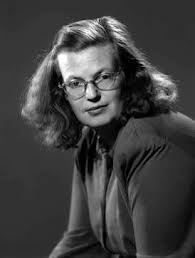
"No live organism can continue for long to exist sanely under conditions of absolute reality." So wrote author Shirley Jackson in The Haunting of Hill House. Shirley Jackson's reality was one of mental hardship and cruelty inflicted on her by those close to her. She chose to make that her millieu - that it is not monsters human should fear, but ordinary humans. Her works reflected a variety of societal ills and the need for natural separation from society.

Born December 14h, 1916 in San 
Francisco, Shirley Jackson never fit in with other children. She preferred to read or write instead of pursuing friendships. Her mother became pregnant early in her marriage and resented Shirley for taking her focus away from her husband. She berated Shirley for her weight and appearance and for being an outcast. The family moved to New York when she was a senior in high school. After graduation in 1934, Shirley studied journalism at Syracuse. She met her future husband while they both wrote for the school literary magazine, and they married in 1940.

Her husband became a professor at Bennington College in Vermont. He often carried on affairs with his young female students. Shirley and her husband had four children and Shirley balanced her family, being a writer, being a faculty wife and being well read - their home library contained 25,000 books. In 1948 she published her short story The Lottery in the New Yorker. The magazine and Jackson received hate mail, as the story exposed a darker side of humanity. (I read the story for eighth grade 36 years ago and still can't shake it. )

Shirley wrote several novels and short story collections. She based her second book on the Paula Jean Weldon disappearance (still unsolved today.) Jackson's work continued into the 1950s. In 1959's The Haunting of Hill House, four people (a Paranormal Investigator, a wallflower young woman, a Bohemian artist, and a young man) must stay in a haunted house. The four experience supernatural events in the home. The Haunting of Hill House was made into a film in 1963 and 1999, and as a TV series in 2018.

Jackson wrote her final novel, We Have Always Lived in the Castle in 1962. Two sisters live alone in a crumbling old mansion.  One sister is suspected of murdering their family. When a long lost relative arrives, the sisters resent the intrusion. Jackson's health began to decline. She developed chronic asthma due to her smoking habit. She faced severe anxiety and agoraphobia exacerbated by her illnesses. Shirley Jackson died in her sleep in 1965 at 48 years old. Jackson was a master in fear and taught the world not to be afraid of  outcasts - instead be afraid of those who cast out.


SOURCES ~

Shirley JacksonWikipedia.

Tuesday, September 24, 2024

"WELL THIS IS JUST A LITTLE PEYTON PLACE..."


Every author has the same dream : they sit at a typewriter and the words pour out of them. The story is cohesive without a struggle. They make a statement the world needs to hear. The world speaks back by making the book a smash success. That happened to Grace Metalious, author of Peyton Place. But literary success trapped Grace Metalious into living a life as tawdry as one of her characters. Grace Metalious died an alcoholic victim of her own fame.


Born into a life of poverty, Mary Grace de Repentingy was raised by her grandmother and mother after Grace's father deserted the family in 1934 when Grace was 10. Grace's mother held literary ambitions that never came to fruition. Grace married George Metalious, her high school sweetheart at 18. George went to college on the GI Bill to become a teacher. Grace stayed at home with their three kids and wrote, often neglecting housework and mothering. Grace had chosen a name at random from a directory of New York City literary agents - Jacques Chambrun. Previously she sent him a manuscript that received no attention. By the summer of 1955 at 30 years old, Grace Metalious would change popular literature with a pot boiler book.


Chambrun sent Grace's new manuscript, The Tree and The Blossom, to Lippincott publishing. Lippincott's reader loved the book, but editors passed. The reader mentioned the book to the head of Julian Messner books. She loved the book, but wanted to change the title. Peyton Place became the book's new moniker, to evoke the idea that the book was anchored in a town. Grace was returning home from swimming with her kids, arms full of groceries when she spotted a telegram from Chambrun.


Two days later she and Chambrun celebrated at New York City's Swanky 21 to toast Grace's book deal. A friend of Grace later noted - "Grace Metalious would never be really poor or really happy again." The publishers put the word out early about the corker of a story, creating what is now termed as buzz. The book hit the best seller list before its release date of September 24, 1956. Peyton Place sold 100,000 copies in its first month. Reviews were unkind, with one critic saying Peyton Place was literary sewage. Grace fired back if "I'm a lousy writer, then a hell of a lot of people have lousy taste."


The novel turned life in a sleepy New England hamlet into a soap opera. Characters made their lives on lies. Women had sex (and liked it!) The novel forced taboo topics of abortion, incest, alcohol addiction, and murder onto readers. Polite society would never discuss these topics publicly, but they sure would read about them privately. Peyton Place became a term for secrecy and judgment - the country music hit Harper Valley P.T.A. includes the line "Well this is just a little Peyton Place..." to expose Harper Valley's hypocrisy.


Grace was asked in nearly every interview she gave if Peyton Place was her autobiography. It wasn't, but Grace's life began to imitate her art. The money she earned allowed her to drink more than before. She and George both had affairs. Rumors and innuendo followed Grace wherever she went, like the gossip that she had shopped in the local supermarket naked underneath a mink coat. Publicity played up the housewives / mother / wife of a school teacher angle of Grace's life, but townsfolk didn't like being reminded their high school principal was married to a scandalous celebrity author. Grace and George separated after George lost his job. Their kids lost friends. Grace slipped further and further into a bottle.


(Side note - Grace once gave an interview to a young a young TV journalist named Mike Wallace. At the television station an up-and-coming young actress, the girl who announced station breaks, helped Grace with a fashion crisis. Ten years later that actress would follow in Grace's saucy, sassy literary footsteps with her own salacious scribblings, when Jacqueline Suzanne released Valley of the Dolls.  Grace Metalious stomped about in jeans and sneakers so Jacqueline Suzann could strut in couture and heels.)


As with any literary smash Hollywood bought the rights to Peyton Place and turned the novel into a film.  Fittingly the deal was signed at the Alogonquin, drinking grounds of Dorothy Parker and Robert Benchley. Grace Metalious netted $250,000 for the film rights. The Metalious family traveled to Los Angeles to watch the filming. The studio shelled out for luxury accommodations, limos, and fine dining. Grace's daughter met Elvis on the set of one of his films. But that was nearly the end of Grace's commitment to Peyton Place. The film netted nine Oscar nominations but zero wins. Peyton Place then became television's first dramatic serial. Peyton Place aired three nights a week for five years.  The show netted the network $62 million, but Grace Metalious signed away the TV rights, never earning any money from the novel's television success.


Grace Metalious burned through nearly $1 million. She bought and renovated a home, bought a cadillac, fancy clothes, and took Island vacations. Grace met a D.J. named T. J. and began an affair. T. J. encouraged her outrageous spending. George burst in on the two and took photos as proof of an affair to be able to divorce grace. Grace filed for divorce, promising to fund George's Master's Degree in exchange for the illlicit pictures. Their kids went to live with George in Massachusetts. By 1960 Grace was left without a lover (T. J .split), her family, and her money.


She accepted a $165,000 advance for Return to Peyton Place, but turned in 98 pages of pages of gobbledygook that needed to be ghost written.  Return to Peyton Place and two other non-Peyton Place novels flopped. The sequel's film version did not see as much success as the original. Return to Peyton Place became a daytime soap opera, airing from 1972 to 1974. By that time Grace Metalious had been dead for nearly 10 years. She met a British journalist, John Rees, in 1963. Rees kept friends away from Grace. Grace changed her will so Rees would inherit her (now meager) estate. Upon embarking on a trip to Boston, Grace's liver gave out. Her children contested her will and discovered Rees was married and a father. He backed off his claim to Grace's estate. Her agent had stolen from Grace for the 10 years they worked together. Grace's drinking burned up the rest of the money.

The woman who literally wrote the book on small town scandal became the biggest scandal her small town had ever seen.


SOURCES :

Callahan, Michael. Peyton Place's Real Victim. Vanity Fair, 2006.

Grace MetaliousWikipedia.

Peyton Place ~ NovelWikipedia.

Peyton Place ~ FilmWikipedia.

Peyton Place ~ Television SeriesWikipedia.


FURTHER MEDIA

Peyton Place ~ Film Trailer


Thursday, August 29, 2024

OH THOSE BEAUTIFUL DOLLS


Any reader has probably gone to see their favorite writer on a book tour. But, have those readers questioned how book tours came about? Well, we readers can thank a brassy former actress who wrote a scintillating book about Hollywood performers popping pills. Jacqueline Susann promoted her books in bookstores, giving readings and signings, meeting fans of her sassy and salacious showbiz stories. She was her own brand, her novel selling because of her personality rather than her talent.


Jacqueline Susann was the only child of Jewish parents; her father was a painter and her mother, a teacher. Despite one of her teachers encouraging her to become a writer, Susann felt the stage to be her calling. Upon her high school graduation in 1936 Susann trod the boards in unsuccessful plays. She also wrote a few unsuccessful plays. She worked steadily in television, even writing commercials she appeared in. She hosted a TV show designed to help people in need find jobs. She married press agent Irving Mansfield. The couple had a severely autistic son who was institutionalized ; devoted parents, Irving and Jacqueline visited him weekly.


In 1966 Jacqueline Susann wrote Valley of The Dolls, a roman-a-clef about three gals who start their showbiz careers together. Their careers go in different directions, but these ladies all abuse "dolls" - amphetamines and barbiturates to retain a career edge. The book was sexy and trashy. Gloria Steinem gave Valley of the Dolls a poor review. And readers gave the book 65 weeks on the best seller list, making it the most sold book of 1966. In fact Valley of the Dolls was the largest selling novel as of 2016, with 17 million copies sold. Of course Valley of the Dolls became a film ; of course the film was poorly reviewed. (Susann was purported to not like the film version.) Susann's other novel sold well enough. She was the first author to have three consecutive novels top the New York Times bestseller list.


Suzanne's brash nature made her a popular and frequent talk show guest. Both Gore Vidal and Truman Capote sassed Jacqueline Susann (when they weren't sassing each other.) Susanne marketed her books with talk show visits and ads in entertainment sections of major newspapers. She toured in support of each of her books. Suzanne also wrote thank you letters to every bookstore owner who hosted book events for her novels. Jacqueline Suzanne died of cancer September 21st 1974. She lived a life of literary fame that made her far more famous than her characters.


SOURCES :
Jacqueline SusannWikipedia.


FURTHER MEDIA : 

Valley of the Dolls ~ Film Trailer

Thursday, July 25, 2024

HOW TO SIN ON A TIGER SKIN


Would you like to sin

With Eleanor Glyn 

On a tiger skin? 

Or would you prefer 

To err 

With her 

On some other fur?


That doggerel was written about Elinor Glyn, who wrote trashy books long before there was more than one shade of gray. Elinor Glyn created the concept of "IT," an undefinable magnetism that draws people to an "IT" person. Elinor Glyn wrote novels, short stories, and screenplays. She directed adaptations of her own films. Elinor Glynn was a woman far ahead of her time.


Elinor Glynn was British but raised in Canada. Her father died when Elinor and her sister Lucille were young. Their mother remarried and the family returned to England. Her grandmother raised Elinor and Lucille to be of the upper class. Lucille married and took on the title of Lady. Elinor married wealthy barrister and landowner Clayton Glyn. They had two daughters, Margot and Juliet. Elinor's marriage was troubled and Elinor had affairs, including an affair with politician George (husband of penny princess and past TYDKYNTK subject Mary Leiter.)


Lucille had always been interested in fashion. She eventually married Cosmo Duff-Gordon and started a fashion empire. The two survived the Titanic. Elinor had always loved books and writing. She wrote Visits of Elizabeth in 1900. She toured America in 1907 to promote the book, sailing on the Lusitania. She took a three week train trip across America, journeying as far as California. After visiting Hollywood Elinor decided to dramatize her novel. Upon returning to the UK she wrote a sequel - Elizabeth Visits America.


Glyn continued to pioneer romantic erotic fiction, a new literary concept for the era. In her novel The Man and the Moment she created "IT," an undefinable concept of mystique and interest, a magnetism that draws people to a particular person, but is not specifically sex appeal. When World War I broke out she became a war correspondent in France. She was one of only two women present at the signing of the Treaty of Versailles. She returned to Hollywood for the filming of her novel The Great Moment. She signed with Hurst International Magazine Company, writing about health, beauty, fashion and relationships and sex for Cosmopolitan magazine.


Glyn was offered a screenwriting contract with Famous Players Laskey for 10,000 pounds. She began calling herself Madam Glyn. (She had no claim to an aristocratic title like her sister Lady Lucy.) Glyn cultivated a persona of elegant sexuality, decorating her suite at the Hollywood Hotel with silk, satin, and animal skins. When her contract expired in 1922 she signed with MGM to write screen plays and direct films. She directed the film version of "IT" to box office success ; the film starred Clara Bow, who came to personify the "IT" girl.


With an aling mother and owing a great deal of taxes in the states, Elinor Glyn returned to England and opened her own film company in 1929. Her British films did not fare as well as her American ones. England had stricter censorship codes than America at the time. She closed her studio soon after. Elinor Glyn had always sold herself as a product as much as her novels and films, but England had no concept of celebrity as did America. 


She continued to write for film magazines, but her novels did not seem as titillating as they had before World War I, given the freedoms women took on in the 1920s. Elinor Glyn died in 1943 at the age of 79. Since then she's been mostly forgotten (but was name checked by Tom Branson in an episode of Downton Abbey.) Elinor Glyn created the idea of the media star, using whatever talent and appeal you have to impress yourself on the public through all available media platforms. Anytime an influencer is mentioned in the mainstream press, they should thank Elinor Glyn; whatever "IT" is that a celebrity has they have "IT"  thanks to Elinor Glyn.


SOURCES :

Elinor Glyn. Wikipedia.

Cummings, Denise K. / Kuhn, Annette. Her British Career / Her American Career. Women Film Pioneers Project.


FURTHER MEDIA

BOOKS

The It Girls ~ Karen Harper


VIDEO :

Elinor Glyn Explains "IT"